19 December 2010

Reviewers all miss the boat on occasion, but reviewing Split Enz's classic True Colours album in Smash Hits of 7 August 1980, David Hepworth shows he has yet to identify the songwriting skills of Neil Finn. Later involved in startups such as Mojo, Empire and The Word, Hepworth would become of the music press's most astute (and sympathetic) reviewer of things Finn.

Split Enz, True Colours (A&M)
A monster hit in their native Australia after years of work, but it’s tempting to assume this has more to do with patriotism than taste. What we have here is a rather slight collection of high-tech pop which takes in a wide variety of post-punk styles and does boast the odd appealing melodic flourish. But it does lack substance in the songwriting department and tends to come across as a mite secondhand. (5 out of 10). David Hepworth

25 October 2010

Taking Woodface to the World, 1991


A cover story from the New Zealand
Listener in 1991, at the beginning of the worldwide campaign to publicise Woodface. At the time, the recruitment of Tim Finn was causing debate. Interesting to see there is no mention of 'Weather With You'.


Neil Finn: A New Lease for Crowded House

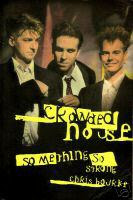
By Chris Bourke – NZ Listener, 21 October 1991

IT IS MONDAY morning, and Crowded House are in Auckland. Tonight there’s a one-off concert in a small club, and tickets are at a premium. Fans who weren’t quick enough to buy tickets before they were snapped up by the radio stations are ringing all their connections looking for spares.

By the end of the week Crowded House will be in Canada. A concert on Friday in Vancouver is the band’s return to the big-time, or so they hope. The North American tour is four months of concerts five nights a week. The goal is to regain the status they achieved in the heady days of 1987, when ‘Don’t Dream It’s Over’ and ‘Something So Strong’ slowly became hits and the band, to their surprise, became international pop stars and scenemakers. On this side of the world the reviews for Crowded House’s new album, Woodface, have been ecstatic, but they always are. The critics have been a little more restrained in Britain and America. Neil Finn reads all the reviews, and remembers them.

But he has nothing to worry about with Woodface – it’s the mot consistent Crowded House album yet, a strong collection of pop songs, most written in collaboration with his brother Tim. It’s a pop album in the old tradition, full of melodies and lovingly put together. The arrangements are sophisticated but the band’s characteristic exuberance is still there. Once again, the reviews are full of Beatle references – so is the album – and it’s with a similar combination of charm and irresistible tunes that Crowded House won over the Americans in 1987.

For drummer Paul Hester the impending American campaign is “the Foreign Legion thing”; for Neil Finn it’s “the descent into Hell”. This Auckland stopover is a warmup: a day’s round of interviews and then the concert for family, friends and fans. It’s also the local unveiling of the band’s new lineup. The recruitment of Tim Finn has received a mixed response among the band’s followers here. Some are pleased to see the elder Finn back in the limelight; others mutter that the three-piece is getting mighty crowded, and wonder how the world will resond.

In the foyer of Auckland’s new Hotel Centra, the Finn brothers just miss each other. Tim wanders off to an interview just before Neil comes by, warning, that he’s a little weary. “We had a family night last night, then I couldn’t get to sleep.” He sits back in his armchair, friendly as always, but also with his usual determined look. There is no need to coax him into talking: an interview with Neil Finn is like eavesdropping on an analysis session. For an hour there is no let-up; the problem isn’t finding answers but space for questions. The words flow out at over 100 per minute, in a trans-Tasman accent. But, for all his articulateness, Finn gives little away that he doesn’t want to. He has been giving interviews since 1977 when, at the age of 18, he was recruited by Tim for Split Enz.

‘It’s Only Natural’ is a song off Woodface, and one of the bounciest, with spirited fraternal harmonies. That’s just how Finn sees the latest development in his band: natural. He recalls this childhood in Te Awamutu, standing with Tim in the hall, practising the harmonies of ‘Jamaican Farewell’ before performing for their parents’ guests. ‘Against our will most of the time, but you always enjoy those things afterwards. You bask in everybody’s appreciation of it ... Yeah, we’d sing a lot. And I’d roll along to Tim’s rehearsals in the early days of Split Enz, and even before that, in school. So there was always an active involvement together. Never more than there is now, though.”

During the heyday of Split Enz, an awkward but regular part of the stage act was the brotherly banter between the Finns. Tim would patronise his younger brother, who by that time was writing many of the band’s hits, and attracting most of the teenage fans. “It was kind of uncomfortable for me, too,” says Neil. “People would come back after the show and ask, ‘Are things all right between you and your brother?’ Because there was this ongoing slight teasing. It may not have been very natural, but it was only intended as being something humorous. People sometimes misunderstood it, or saw some darker interpretations.”

In those days, the pair never wrote together, and there was little in the music to reflect the years they’d spent trying to out-sing each other as they belted out Beatles and Bee Gees songs. After the success of his first solo album, with its hit ‘Fraction Too Much Friction’, Tim left the band he’d founded. For the next few years, he lived in London and travelled the world. He put out two more solo albums that were less-than-successful commercially. Many of the songs were excellent, but their mood was downbeat and brooding. After his relationship with Greta Scacchi came to an end, he returned to Melbourne. “Tim coming home was like a renewal of connection with his roots,” says Neil. “He probably had the most difficult transition out of Split Enz of any of us, because he’d completely severed ties, though we were talking on the phone. Returning to Melbourne was important for him. It was the first time he felt he had a community of people that he could rely on.”

With the Finn brothers living near to each other, the pair got together to collaborate on a duet album. From the very first day things clicked. “It was bizarre. We were ripe for it. We’d just start singing, anything, and someone would find a harmony, and then a melody would appear, and we’d seize that. Because there were two of us, we wouldn’t give up and go and have a cup of tea. We’d say, ‘That was good, let’s finish it now.’”

But it was time to record the third Crowded House album, which was crucial to regain the band’s momentum in America. It didn’t’ go so well. Recording came to a halt when the band weren’t happy with the last few tracks. So Finn had two unfinished projects at hand: one he was excited about, the other stalled. “They kind of intersected. One problem became the other’s solution.”

The obvious answer was for Tim to join Crowded House. The only thing in their way was “people’s perceptions of us, that they wouldn’t accept it. Once we’d put that aside as an objection, it seemed very natural. But with a public profile, it’s hard to make unselfconscious decisions about the band.”

The same day Tim and Neil discussed the idea, they went around to talk with the others: Paul Hester and bassist Nick Seymour. “We said, we think Tim should join the band because these songs would be great Crowded House songs. It would be a good time for Crowded House to redefine itself.

“They initially were quite ... nervous about it. They’re nervous about me coming to them with massive ideas that they haven’t been privy to. I do tend to drop bombshells on them a little bit. And this was another one. They were probably slightly nervous about there being a Finn brothers’ power bloc, that it might affect the chemistry of the band, that it might seem like Split Enz revisited, which no one wanted. After a day or so, when we listened to the songs we’d started, they got excited as well ...”

Without pausing for breath, Finn outlines the positive aspects of the change; it’s ground he must have turned over in his mind many times in the past few months. “It diffuses the tension between the three of us. As an outsider Tim can see certain situations and explain my frustrations to them – and vice versa. Anybody else joining would have been much more difficult. I was in a similar situation when I joined Split Enz. I understood the aesthetic, and I think he understands the aesthetic very well. Timm is very mindful of absorbing himself into the Crowded House style of performance. He realises that’s the only way it’s really going to work.”

Crowded House has worked hard at its light-hearted, approachable image, whereas in performance Tim Finn has a theatrical, though rather aloof, manner. Neil says he finds his brother “compelling” to watch on stage. “He’s incredibly intense, almost W C Fields-ish, whereas we’re very intimate and conversational with the audience.” But Tim is developing the Crowded House style, loosening up. “We didn’t want to be a schizophrenic band. If something’s working, don’t fix it. To Tim’s eternal credit he’s totally aware of what Nick and Paul bring to the band, and of not affecting the chemistry to the detriment of the band. We’re a fragile enough unit anyway, we always have been ... delicate, you might say.”

With his characteristic sardonic humour, Paul Hester told an American interviewer that accepting Tim was hard at first, “because it meant the end of ‘Curly, Larry and Moe’. But once we started working together, it all seemed perfectly normal. Besides – now we have someone to blame if the record stiffs.”

THERE IS a lot hanging on the success of Woodface, and not just financially – although some in the record industry have estimated that the slowly gestating album, with its slick production and lavish videos, might have cost around $US 1 million. Compared to the success of their debut album Crowded House, the follow-up, Temple of Low Men, was almost a “stiff”. The record eventually “went gold” (sold 500,000 copies) in America, but the band lost hteir career momentum. The reasons had little to do with music – many critics and musicians now regard the album as one of the best of the 80s – and a lot to do with the business.

The record’s first single ‘Better Be Home Soon’ never took off on American radio. After the jaunty pop of ‘Now We’re Getting Somewhere’ and ‘Something So Strong’, the programmers were bemused by the darker themes of the Temple songs. “They thought ‘Better Be Home Soon’ was country, so they wouldn’t touch it,” says the band’s straight-talking Australasian manager, Grant Thomas. “Radio there is so format-bound. Hell it pissed me off.”

And after nearly two years of touring to support the first album – it was a slow starter, and when it took off, the band had to stay on the road to take advantage of its success – Neil Finn was worn out. He decided not to tour the United States to publicise Temple.

“That probably didn’t help matters, but largely speaking the record company lost that album in America through their own bungling,” says Finn. “But because we were such a big part of the first album’s success by going out and charming the Americans, when we didn’t do so much for the second album, that was perceived as the reason it didn’t happen. But that’s only ever part of it. ‘Better Be Home Soon’ was No 1 in Canada and New Zealand, and No 2 in Australia. There’s no way that people are that different that it wasn’t a hit. But when it ran into trouble they just panicked. And we weren’t there to buoy their confidence. But there is a lot involved. The number of good songs that fail in America is staggering. There are no givens.”

This time, however, the band’s strategy seems to be right. Their relationship with their record company, Capitol, has “never been better”. The head of the US company is a relative of their American manager. “And luckily, after years in the doldrums, the company is really happening at the moment. Largely through MC Hammer, Bonnie Raitt, Poison – a whole bunch of people who are making them a lot of money. And we are their ‘number one priority internationally’ this year.”

Many people were surprised when the song ‘Chocolate Cake’, with its critical images of American indulgence, was chosen as the first single. But that was the record company’s idea, after receiving a positive response to it from the influential university radio stations. “They said it was edgy, a little confrontational, and if anybody didn’t like it, great. We got far more controversy about the song in Australia than in America. People were having phone discussions on the radio about it: was it anti-American? Was it all right that we should be saying these things? In America they just ... laughed! It was far more important that we were talking about American icons than what we were saying.

“The proof was in the pudding. It got to No 1 on alternative radio, and was really thrashed on stations like KROQ in Los Angeles.”

Now the alternative stations have ‘It’s Only Natural’ high on their playlists – a fact the band’s management is downplaying here, in case it takes airplay away from the second single, ‘Fall at Your Fee’. “That’s more traditional for us. I think it’ll break through. Overall I’m extremely confident with the record, and we’ve got the energy to go out and stand behind it. We’re in it for the long haul.”

Finn says the band has never had a game plan for their success. “That sounds ridiculous because we have been ambitious, we have gone about things deliberately. But we’ve never had a master plan of where we were heading, it’s been more alike stumbling along.”

After Temple Finn took some time out as his wife Sharon was having their second child. It gave him a chance to reflect on the band. “The whole experience of being the globe-trottin, high-profile, fun-loving outfit from Down Under was starting to wear a bit thin. I felt like we were becoming a bit of a parody of ourselves.

It also provided the opportunity to “sort out a lot of things that were ... inherently problematical in the lineup of the band”. Like what? “I don’t want to get into it; it’s like discussing your marriage. Just personality things that were occurring, patterns we needed to break out of, which we did. And I had the time to think, ‘Does this really mean enough to me to launch into it again, and give it my best?’ I figured out it does.”

At the time of Temple Finn talked about the marketing getting in the way of the music. “It is a distraction, it gives you far less time to write. If I worked in the traditional role of a songwriter, as it was 40 years ago, I would have four times more songs written by now.

“But to moan about it seems a little petty. Frank Sinatra had a go at George Michael recently for whinging about being successful. I don’t think Frank Sinatra has much to speak of in terms of values, but he’s right on that score. I wouldn’t want to be seen to be whinging about our position. To continue to make records, you’ve got to have your face in front of the public, and I’m quite happy to do that. I think I understand where to draw the line a bit better now.”

THERE IS nothing like the return home of local boys who have made good. The air of excitement at the concert that night has been rivalled this year only by the opening of La Boheme [with the return to the New Zealand stage of Kiri Te Kanawa]. Before the doors opened, hundreds of people were lined up outside the Power Station venue, being bombarded by the sound systems of two rival stations as they waited. Inside, the band was going through the musician’s equivalent of politicians kissing babies. There was family to greet and the media to meet. Those odd bedfellows, the music and radio industries, were schmoozing as if they never have any differences. “I’m deeply flattered,” said Tim Finn of the “radio wars” outside. “Fifteen years ago we were told, ‘We don’t play that sort of stuff.’”

The evening was always going to be an event and the band rose to the occasion. The charm of the old Crowded House remained – the low-key acoustic numbers, the rapport with the audience, the singalong melodies – but, for this local gig at least, the balance had shifted with the addition of Tim Finn to the trio. As Neil says, his older brother does indeed have an intense aura about him. The band didn’t come across like an Everlys-style duo, as on the record’s best moments, or as the old three-piece with a new supporting player. Instead the limelight was firmly on Tim whenever he stepped forward, while Neil moved back to his former sidekick role in the Enz. Neil has become the stronger singer, but a special moment was Tim Finn’s still-fresh ‘Six Months in a Leaky Boat’, with its inspirational rallying call: “The tyranny of distance/never stopped the pioneers. Why should it stop me?”

Earlier in the day, while getting his photo taken in a bright green suit made from billiard table cloth, Neil Finn had talked of the two-edged attitude New Zealanders have towards those achieving success overseas. Back home, we want them to take on the world and win, but still the same. He mentioned something similar on TV’s Nightline. When you’ve succeeded, the proper response is to act like an All Black from the golden era: after scoring, put your head down and walk back, impassive.

During the photo shoot, the talk was of other prominent New Zealanders, and the love/hate relationship we have with them. [All Black fullback] Grant Fox mentioned it in the Herald this morning , said Finn. “The attitude seems to be, ‘Sure, we’ll give you hero status, mate – just don’t stuff up.’”

28 April 2009

Worlds Where We Live

I was just alerted that if you search on Google Books for Something So Strong, apart from everything else it comes up with - edited scans, for example - is this nifty map of all the places mentioned in the book. As a map aficionado, that gives me a buzz.

Not quite as big a buzz as The Word's Album Atlas, however, though it uses the same technology. It shows the places where the cover shots of hundreds of albums were taken, from Abbey Road to Karekare to Muscle Shoals to Timbuktu. Now that's addictive.

20 December 2008

Separated at birth


The Charleston Jazz Band, Australia, 1927; Split Enz, 1975/76

17 July 2008

Songlines


Sorry no longer seems to be the hardest word. In the same week that the Pope congratulated Australia for its “courageous decision” to apologise for the injustices done to Aboriginals (and then apologised for the paedophilia scandal), an album by an Aboriginal singer has topped the Australian independent music charts for the first time. This is a significant moment in Australia, where over the years the charts have been a whiter shade of pale.

Geoffrey Gurrumul Yunupingu is 38, blind, and grew up in poverty 600km from Darwin. He speaks only a few words of English, is extremely shy, and sings in his native language: Yolngu. He taught himself drums, keyboards, guitar and didgeridoo – all by ear, he doesn’t read Braille – and critics have been raving about his voice. It sounds like he is being groomed as the heir to the world-music-pop throne of Hawaii’s Israel Kamakawiwo’ole.

The Sydney Morning Herald’s critic Bruce Elder wrote that the first time he heard Yunupingu, “My immediate response was that here, as far as I was concerned, for the first time was an Aboriginal voice of absolutely transcendental beauty.” Yunupingu may be new to being a solo artist, but he spent many years with the well-known Yothu Yindi band before forming his own Salt Water Band (the coastal version of LRB?).

Paul Hester once told me about the time he recorded an Aboriginal band in his Melbourne home studio. He asked them where they came from. “Fitzroy,” said the band leader, naming the inner-city shabby-chic Melbourne suburb that was then being gentrified. Naah, c’mon, said Paul: where did you originally come from?

“Fitzroy,” the band leader said emphatically. “Listen mate, we’ve been here for 10,000 years.”

27 May 2008

Playing Hard to Get

Eddie Rayner interview, 1988


By Chris Bourke

Rip It Up (New Zealand) September 1988

In the final concerts of Crowded House’s recent Australian tour, drummer Paul Hester went into a rap: “We’re making records / Ed’s making babies / It’s been fun / But it’s coming to an end.”

As always, Eddie Rayner is fending off tempting offers. The latest is to join Crowded House as a permanent member. Affable and accommodating, he’s worked with musicians ranging from the Angels (a month was all he could stand) to Paul McCartney (a “creative disappointment” he’s talked about too much already).

It’s a matter of priorities, he explains. He loves the music and the band, but he wants to do his thing, and Crowded House theirs. And Rayner isn’t interested in the “bullshit” required: the touring, promoting, record companies, managers. Then again, Hester’s farewell isn’t the first time the band has said goodbye to him.

“When Split Enz broke up, there were heaps of things I’d wanted to do for years,” says Rayner. “My wife Raewyn [the Enz’s lighting director] wanted a family, and we’ve now got two little boys, one just a few weeks old.

“When you’re in a band as committed as Split Enz, you can become very blinkered. You think about the band and not a lot else. I had to take control of my own life, and not get dragged along by the band. So I sat down and made a list of priorities. I wanted a family, to write, and have my own studio. Touring came a poor last. I love it, and it’s necessary, but you’ve got to think about it, otherwise you end up doing it forever.”

Rayner has an eight-track, all Midi, studio at his home in Melbourne. He’s been working with Brian Baker, an Auckland songwriter based in Australia – “we’ll probably become one of those awful duos” – and recently he wrote and compiled the soundtrack for the film Ricky and Pete.

“It’s a comedy about two middle-class kids from Melbourne who go into the outback to pull the wool over corporate eyes. It was an in-house affair: Schnell Fenster played the songs, but Crowded House got the best part of the music, the driving scenes. I wanted to do them, but fell in love with their ‘Recurring Dream’.”

He’s trying to adhere to his priorities. “The family comes first. I get offered lots of sessions, but don’t really like that too much, I’ve never worked as an employee.” He also likes to have some quality control – “When I do some crap, I know it.”

An instrumental album is in the works, though after doing a few tracks, his interest is waning. “It’s not as fulfilling as working with a bunch of people.” With characteristic candour, Rayner describes his instrumentals recorded with Split Enz as “just appalling. Awful. When I look back at them, I wonder how they got accepted.”

Rayner says he got all his musical training in Split Enz. “It was a great environment to learn in. Otherwise I’d still be doing cabaret. I learnt so much from Tim, Phil, Neil, Rob – the amount of creative talent was staggering.

“We were incredibly wayward musically. And we used to stumble along, with no game plan. These days young players know so much about the industry, publishing, recording, before they even start.”

Ironically, Rayner seems most at home playing live. During the theatrical shows of Split Enz, or the spontaneity of Crowded House, he’s always got an appropriate line to colour and connect the looser moments. “There’s a lot of covering in the band – that’s why Neil has asked me to join. The whole band likes jamming a lot, and it’s just about my favourite past-time.

“I’ve bluffed my way right through. Some great jazz musicians have invited me to play with them, and I’ve said, ‘You’ve got to be joking!’”

One of our earliest electronic keyboardists (and still probably our best), Rayner regards the day Split Enz bought their Mellotron as ancient history. “The old days” for him are 1980, when he graduated from monophonic synthesisers to a Prophet and Jupiter 8. “I like to have new stuff when it comes out. I don’t read manuals, I hate them.” Still, he’s proficient at listing his gear for techno buffs:

“I’m still using bits and pieces,” he says. “Lots of modules. A DX7, C2P50 piano keyboard with weighted action, through a MXS piano module. An MKS 80 Super Jupiter, S612 Akai sampler, D110 Roland S330, all through an Akai Midi patch bay – and I’ve finally got a Korg stereo mixer!”

As a child in Howick, east Auckland, Rayner had only four piano lessons, though his father was a “brilliant” player, taking on any big-band hit at parties. “I’d love to be able to do that – when someone says ‘play a song’ you can carry the tune and be the whole orchestra. But you’ve got to spend years playing.”

At university in th eearly 70s, while his peers “got serious” with their studies, Rayner joined his first band at the behest of his friend Steve Hughes, bassist with Tramline. “I owe it all to him. We went down to Kingsley Smith’s and bought a Vox organ.” Early bands included Hungry Dog (within initial Enz guitarist Wally Wilkinson), Orb, Cruise Lane, Stuart and the Belmonts (with Brent Eccles, now drumming with the Angels) and Space Waltz. “For a while I was with Space Waltz and Split Enz: so was Mike Chunn”

Ah, Space Waltz, our glam rock pioneers, and the most entertaining moment of TVNZ’s recent nostalgic music weekend. The Bowie posturing of Alistair Riddell still has surprises, as it did in 1974’s New Faces programme. “ ‘Out in the Street’ should be in an art gallery,” laughs Rayner. “We actually did an album. It’s a laugh a minute – you gotta read the lyrics! But some of those old Stebbings or EMI recordings still sound great on radio.”

He ruefully mentions recent Rip It Up ads from overseas buyers seeking classic local records. “That shits me. To think of a few years back when you could go into a store and buy any New Zealand record from the bargain bins …

“I always think about coming back to live in New Zealand. But I probably never will.”

Postscript: Rayner returned to New Zealand to live in 1993. In 1996 he launched Enzso. More recently he has been leader of the house band for New Zealand Idol. Here is Space Waltz, from 1974: when this was first shown on a TV talent show, the nation was shocked – then sent the single to No 1.


26 May 2008

Nice Place You’ve Got Here


An interview with Neil Finn, at the release of Temple of Low Men.

By Chris Bourke

Rip It Up (New Zealand), September 1988

“I don’t want to be one of those wankers who falls apart the first time they get a bit of success,” says Neil Finn.

The man from Crowded House must thrive on working under pressure. Hit records? Everyone wants them, depends on them. Finn does too, but he’s determined to get them with songs that he’s proud of. So instead of writing ‘The Dream’s Not Over, Yet’ he has coolly produced an album that’s one step ahead of the choc-full-o’-hits debut.

“You sense the dangers of success, but there’s a lot more people coming from people whose lives depend on your next record being successful too,” he says. “There’s a feeling that to do anything radical, to suddenly go ‘I don’t want to do that’ is going to effect a lot of people’s lives. That’s the pressure.

Speaking from Adelaide during Crowded House’s Australian tour, Finn says that Temple of Low Men is less singles-oriented than the debut album, as they “let the songs that were around win the day” rather than concentrate on making hits.

“Mind you, having said that, they did put out the most safe choice [‘Better Be Home Soon’] for the first single. That wasn’t exactly my idea. It’s very poppy, but it’s not particularly representative of the rest of the record – there’s more variety and atmosphere on this album. But they wanted they thought was a dead ringer in America, though nothing is a dead ringer.”

Do you like taking risks?

“I’d like to take more than we do, actually. It seems like you’re constantly being drawn to the safest choices and decisions all the time, because that’s what everyone wants for you, or they want for themselves, because it makes their job easier.”

Neil Finn has taken the hard road in popular music, the one marked “highest common denominator” – trying to reach the widest audience with the best music possible …

“Um, yeah,” he says. “I’m certainly not elitist as far as what my desired audience should be. I’m quite happy for anyone to like the record.” Finn says this attitude dates back to when he first got into music. “The thing I most enjoyed was sitting around in a party having a singalong. In those situations the songs that suit best are usually the everyman songs, the ones everyone knows the words to, can sing the melody of … you can usually get a great chorus and feeling out of it. So I’m drawn to that, and I don’t feel very snooty about my audience.

“But I’m pretty desperate to make as good a record as I can, and not be following too many formulas – apart from my own. I think it’s possible to do both: to do something worthwhile creatively and actually be successful as well. It’s not easy but it’s possible.”

After the rousing pop of the debut, Temple of Low Men seems to reflect a more mature Crowded House, in contrast to the amusing, unassuming aspects of the band’s character, especially live. “I like the idea of thumping 12-year-olds with 30-year-old themes,” laughs Finn. “Our audience is quite a broad one, but includes a lot of young people, and it’s good to expose them to things other than the teen stuff they’re hearing. Like the sex trip that most bands are on: ‘Come on baby, give me your everything’.”

The songs on Temple have a soul-baring honesty, examining the various phases of a relationship: temptation, guilt, remonstration, joy, commitment, loss. Any thematic links are unintentional though, says Finn.

“I often feel one-dimensional in that respect. This album is quite introspective. But people should always understand that in any song you try to enlarge on life a little bit, and things that I describe in songs often follow their own tack rather than being directly related to what’s going on with me. Many times you remember things from years ago that steer you in a certain direction.”

And as the writing for an album progresses, the music gets focused …

“Yeah, you go through phases when you’re writing songs. You have certain chord progressions or melodies and stuff, and they suggest atmospheres. I can write something that might sit around for three years, and at the time I wrote it, it didn’t suit.”

Does he ever feel he gives too much away in a song?

“I feel like people think I do. I feel a bit vulnerable because of it, in the sense that people would relate it to my own life. And I suppose I have concern for my family in that respect. It’s not pleasant for them sometimes to see the way people perceive my songs, and that’s a pressure in itself.”

Balancing the brooding ‘Into Temptation’ and ‘Never Be the Same’ is ‘When You Come,’ an ecstatic moment of commitment. “I was pleased with that one. It’s a fairly positive song. Like a lot of them, the lyric came quite subconsciously and it doesn’t really make incredible sense. But there’s a lot of imagery there which I really empathise with.”

Finn’s lyrics are occasionally obscure, but full of imagery, with their meaning only coming clear through the feel of the music, after many listenings.

“It’s the same for me, too. A lot of the time I don’t really understand what the songs are about till months and months later. I have a sudden realisation that, ‘Oh yeah – I know where that would have come from’.”

The swampy ‘Mansion in the Slums’ comes from observations of life in LA, says Finn.

“The twin quest for glory and success, and they’re hopefully married, but people con themselves that they’ve got spiritual values as well. It’s that New Age Shirley McLaine stuff: ‘You are God, it’s okay to be wealthy and successful and just love yourself.’ I dunno, it’s me taking a whimsical look at that. The isolation tank reference is directly from hearing talk from people in LA. There was a spate where people were getting into isolation tanks for relaxation. I’ve never done it, probably I should give it a chance, but I always thought I’d rather bounce round on a trampoline for relaxation.”

The arrangements on Temple have a complexity and wit that producer Mitchell Froom (pictured at right) gets across with a natural clarity.

“That’s probably Bob Clearmountain in many ways, the guy that mixed the record. He’s done a very fidelic, very clear mix. But Mitchell was good at stripping back arrangements, so obviously he was involved.”

The record seems so much your voice – why didn’t you co-produce?

“People seem to take more notice of that production credit than I actually do. Of course I was as involved in the arrangements as Mitchell, but I’ve never been particularly precious about taking credits. As long as the music ends up close to the way I imagined it.”

Although all the songs on the album were written by Finn alone, the band is playing more as an ensemble now. “Yeah, I think we’ve got more subtlety in the feels, we stretch out a lot more,” he says. “Mitchell was a lot more aware of what we were capable of doing, and we were a much better band from having played so much.”

Finn admits that he’s the leader of the band. “Because I write the songs I have much more concern with the way they turn out, I suppose. Nick and Paul are happy to play, get into it, and try and avoid as many interviews as possible.”

Why didn’t Eddie Rayner play on the album?

“It was difficult with Mitchell also being a keyboard player. But I think we were stupid. We probably should have got Eddie on the record, because then he probably would have been available to tour with us all year – instead of being a difficult bastard and only wanting to tour a month or so here and there! He’s an incredibly valuable person to have around, and we beg on our knees for him to tour with us. He’s with us at the moment.”

All the critics references to you-know-who must get tiresome (much of Temple seems like a follow-up to Abbey Road) …


“The Doobie Brothers, right?” laughs Finn. “It’s starting to irritate me now. Most of the time it was meant as a compliment. I’m flattered in one sense, but I do feel now that it’s time I was staking my own territory and people needn’t say those things. On the next album I’ll look at diffusing that. It hasn’t been anything I’ve consciously gone for, but I know it resides in me because people mention it so much. I’m prepared to copy that one, but I’m going to do something about it.”


Aiming for the highest common denominator isn’t the easy route to credibility. Take the veteran US writer Robert Christgau who dismissed Crowded House as “Art pop, obsessed with craft. Full of itself. Product, for sure.” Was he alone?


“He’s probably the most noticeable, but I imagine there were others. To be quite honest I didn’t’ see that many bad reviews. We had a lot of extremely good ones. I’m always wary not to take either extreme too seriously. You learn more from the bad ones than the good ones. The good ones pamper your ego, but the bad ones have a bit of resonance. Even if you disagree with them they get you thinking about your potential.”


Sometimes the hard sell of the last album was off-putting, the cute humour making Crowded House look like the new Monkees. The video for ‘Something So Strong,’ for example – even the band expressed doubts about it when they were last here …


“There are certain things that get away on you,” says Finn. “It wasn’t like we were contriving silliness. It really did come out quite spontaneously. But I’d rather have that than take anything too seriously as far as promotion goes, because really all of it is pretty tacky and by doing it you’re implicated yourself in the whole mechanics of the industry.


The video in question was made by an Australian friend of the band, who had a particular vision. “He liked the idea of, as he put it, ‘tapping into the soft white underbelly of mid-Western America,” says Finn. “He wanted to penetrate the heartland of niceness, and subvert it once we’d got them. But that aside, I think it looked a bit much like a toothpaste commercial myself. Certain people you’d never expect really liked that video. Elvis Costello for one. That surprised me.”


In an interview before Split Enz’s last tour in 1984, Finn reflected that he didn’t think he’d like massive success, saying he’d feel too guilty.


“Yeah, I do have a measure of that. I don’t really know if I enjoy success as much as I should. There’s this feeling that everyone’s expecting you to be incredibly happy about your success. But in many cases what it means – in the short term anyway – is that your life becomes completely chaotic. And you can’t help feeling that it’s having an adverse effect on your ability to keep writing good songs. But that’s not really guilt I’m talking about.”


Did you experience any writer’s block for this album?


“There hasn’t been a year of my life without a good three months in which I haven’t been able to do a damn thing. In fact the first six months of this year I’ve been so busy I haven’t been able to write anything. It worries me. I hate the fact that so many other things become involved in what you do when you make records and are part of the industry, and are looking for success and all of that. You actually do what got you there in the first place less and less – and that’s write songs.”


Speaking of busy, you’re off to the MTV awards straight after the Australian tour …


“Everybody in New Zealand seems to know about that! Why?”


It was given as the reason the proposed August 31 gig didn’t come off …


“Aw, was it?” says Finn, hurt by apparent cynicism. “Fuck them! That’s not the reason we’re not coming. We’re doing the Letterman show in America for starters, and that’s more of a reason. But the main reason it we didn’t’ want to just rush through, in one door and out the other. We’re incredibly busy, and that’s why I didn’t want it to feel like a token appearance in New Zealand. I hate coming in for a day, you see about a dozen people you know quite well land don’t get a chance to talk to any of them.”


To keep your face in front of the pop world, you’ve got to go along with a lot of the hoopla …


“Oh god, there’s lots of things. We’ve tried to avoid some things, and even then we’ve done stuff I wish we hadn’t. You find yourself in situations where it’s very hard to be completely uncompromising on a day-to-day level when you’ve been brought up to be reasonably polite and agreeable about things. I look with envy at people like Chrissie Hynde, who’s able to be a bitch and therefore get what she wants. I wish I could be a bit more like that. I’m sure I’m capable of being a bastard, but I do find it hard to say no to people. But we’ve done this to ourselves, and I figure if 80 percent of what you’re doing is okay, then you’re doing pretty good.”


Rip It Up cover photo (c) Chris Mauger, taken in Sydney, September 1988.