Not on this Saturday morning.
Devon St, New Plymouth, New Zealand,
March 2008.
Not on this Saturday morning.So it was a nice surprise, if not completely unexpected, when Neil offered to come to the rescue after the lead act at this year’s Womad had to cancel. The “barefoot diva” Cesaria Evora suffered a small stroke in Australia, and in her place Neil performed a solo set.
 Since the first two Auckland Womads – which had disappointing sales – the festival has moved 200 miles south to New Plymouth, in the centre of the North Island. There is a strong folk tradition there, a hardcore of old hippies, veterans of the 1980s Sweetwaters rock festivals, and now their teenagers. Plus, Wellingtonians and Aucklanders of a similar ilk only have half the distance to travel.
The setting is sublime: Brooklands Park in the heart of New Plymouth, which is like a botanical gardens of native bush, set around a natural amphitheatre called the Bowl of Brooklands. In front of the stage is a pond between the performers and the audience, often breached in the past by drunks (or by Tim Finn, rowing a dinghy around during ‘Dirty Creature’ in a 1980s Enz show). It has also hosted huge events such as the Seekers at the height of their fame or, recently, a solo show by Elton John.
But the toe sandals are out at Womad, and among the stalwarts there’s a slight atmosphere of disinterest for mainstream pop. Nevertheless the organisers have programmed the festival brilliantly, with mainstream acts at the perfect ascendant moment of their career (Sharon Jones and the Dap-Kings, Beirut) combined with soul veteran Mavis Staples and a top array of “world” music that has broken through to western audiences: Toumani Diabate, the Terem Quartet, Taraf de Haidouks, and the “Ray Charles of Cambodia”, Master Kong Nay. Also there is a strong contingent of New Zealand music at its best: old hands Midge Marsdan and Don McGlashan, plus the Phoenix Foundation, SJD, and the ubiquitous and always welcome Age Pryor.
 Neil looked a little lonely standing on the dark, wide Bowl of Brooklands stage, dressed in a deconstructed navy pinstripe jacket, with a birds-nest hairdo. He opened with ‘She Will Have Her Way’, fleshed out with 12-string acoustic, and then he said, “I’ll now do a song as I actually wrote it”. Starting slowly, and singing Love can make you weep, it took me a moment to recognise ‘Something So Strong’ performed as a delicate demo, using just barre chords.
The thousands of people perched on the hill, snapping their mobile phone cameras or waving fluoro-lights made Neil say “I feel like I’m tripping”, and he responded with ‘Silent House’: All the flickering lights / had filled up this silent house ... His electric guitar provided a raga-like drone as a bed, to song that just gets more captivating.
In a set of favourites – this was a middle-New Zealand crowd, rather than a crowd of Crowdies – ‘Only Talking Sense’ sounded very fresh. A subtle ‘Private Universe’ and exquisite ‘Four Seasons in One Day’ would have coaxed a sing-along elsewhere; at the Bowl, it’s always a bit tricky trying to connect with the audience over the moat.
‘Anytime’ is a hidden gem off the One Nil record, but even more glorious performed live, with arpeggios from roadie John adding to its dramatic build. Don McGlashan emerged with his euphonium for ‘English Trees’, Time on Earth’s real stayer. Its mournful tones were just perfect to take the Hammond organ solo on a slow, careful ‘Don’t Dream It’s Over’: it was like a Salvation Army band coming down the street, the very sound Neil was aiming for on ‘Together Alone’. The versatile McGlashan and whatever band he chose to perform with would be the perfect support act for the next Crowded House tour.
 As the crowd melted into the trees and home to bed, on one of the smallest stages Age Pryor and his Suspicions were going off. Check out his 2007 album Shanks Pony: there are enough melodies and harmonies there to be sure that, whatever Crowded House is producing right now in the studio in Auckland, New Zealand’s songwriting is in good hands for the future. Thanks to Womad's smart system of having acts play more than once (to avoid clashes), Pryor was to have performed nine times during the weekend, including his own band, with Jess Chambers and the Firefly Orchestra, and the Wellington International Ukulele Orchestra. A bug (a firefly?) prevented the latter; it would have been great to hear what he added to their spirited version of ‘Weather With You’.

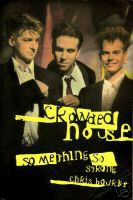
When writing Something So Strong I really enjoyed interviewing long-time Crowded House engineer Tchad Blake. He came on board towards the end of the first album, and was a stalwart during Temple of Low Men and Woodface. Those magnificent textures on ‘Whispers and Moans’ are his work.
Blake is the best kind of Californian: intelligent, relaxed, but not too-cool-for-school. Low-key, and happy to have his achievements speak for him. His work with Mitchell Froom for artists like Los Lobos (the masterpiece Kiko), Richard Thompson, Bonnie Raitt and the Bad Plus certainly do that. Many other engineers one meets are blowhards, but not Blake. His website is minimalism itself.
It’s rare that you see an interview with Blake, and this recent one is really for tech-heads only. It’s about the gear he used to engineer Suzanne Vega’s Beauty and Crime, for which he recently won a Grammy. A much better interview is this one from Mix, when Blake was based at Peter Gabriel’s Real World studio in the UK.
But this posting isn’t about Blake, it’s about the net and how it has made the world a smaller place. It was while writing SSS that I started using the net every day, and it quickly came in handy. There was no Google then, but through user-groups and people’s generosity you could easily get some Irish folk buff who knew the lyrics to, say, ‘The Parting Glass’. Or track down the engineer of ‘Weather With You’ (Blake is the exception to the rule that if someone has a personal website, they will usually love talking.)
In 1996 I was a subscriber to the Randy Newman newsgroup Little Criminals. There were only 60 of us, and I wasn’t one of the half-dozen who regularly posted. The only other site that I subscribed to was Tongue in the Mail, brilliant for tracking down facts and keeping up with the news but, like Little Criminals and any fan site, also an outlet for those with too much time on their hands.
The reason I subscribed to Little Criminals was that Newman’s archivist was also a subscriber, so you got news pretty much from “slot-mouth” himself (to quote one early reviewer of his singing). One day in 1997 the archivist wrote that Newman was about to make his first proper album (ie, not a film soundtrack) in nearly a decade. What did the fans want from it?
Well, I knew what I didn’t want: an album with the Eagles as backing vocalists, Toto providing drums and Jeff Lynne on synths. So I made the case that the album should be produced by Mitchell Froom. Like Newman, he loved the piano, appreciated real, analogue instruments, was a “classical” producer who knew the orchestra and had a palette of sound, and, most importantly, appreciated a good song. He was also intelligent and shared the same mordant sense of humour.
I heard nothing back. But a few weeks later Something So Strong was launched and Tchad Blake happened to be in town. I mentioned to him that some Newman fans were pitching for him and Froom to produce him. “Oh yeah,” he said. “We heard from his people the other day. Unfortunately we’re booked up.”
Bugger. Meanwhile Newman was booked to score Maverick and Pleasantville. A couple of years went by, and suddenly – after 11 years – Newman’s non-soundtrack album Bad Love was released. The producers were Mitchell Froom and Tchad Blake.
I interviewed Newman on the phone about the record. Without prompting, or telling him I had written Something So Strong, he mentioned that Neil Finn was one of his favourite current songwriters:
“Crowded House – that’s of interest,” said Newman. “But most stuff isn’t. I just met [Neil] out here he was doing something. They were good records. I remember Knopfler when we were making Land of Dreams, he just loved that band. I hope he told Neil, or told ’em both.”
So I couldn’t resist telling him the story of how I had written to his archivist suggesting Froom and Blake. He listened patiently then said enthusiastically, “Oh yeah – that’s how it happened.”
 Bad Love was beautifully produced, but not the most consistent set of songs Newman has ever released. Still, ‘Miss You’ is like a heart-breaking haiku, and gets me every time. The album was Newman’s worst selling, he later cheerfully recalled. It only sold 70,000 in the US.
But he went back to Mitchell Froom when the time came to record The Randy Newman Songbook – solo piano renditions of his best songs. It was sub-titled “volume one” but the Little Criminals are still waiting. Froom almost eschews making records to be hits, and he has succeeded at that a few times. But he makes great music, and I’ll always remember Newman signing off the interview: “And hey – thanks a lot for the tip about Mitchell!”
You’d think they might have heard of each other on the tightly inter-connected LA musical grapevine. But then, Brian Wilson didn’t surf, either.
Update: in news just to hand ...
 This is the man who signed Crowded House. His name is Tom Whalley, and in 1985 he was a junior A&R man with Capitol Records in Hollywood. Gary Stamler, manager of what became Crowded House, brought the demos to Whalley. At the time, Whalley had signed teenage bar-band the Del Fuegos to Slash, and put Neil Finn together with fledgling producer Mitchell Froom, thinking, "Well, if Froom can do such a good job with such unpromising material, what could he do with real songs?"
"the discipline - always more art than science - is essential for music companies if they are to muddle through an unforgiving landscape. "It still comes down to A&R," he explained. "None of this works - mobile doesn't work, downloads don't work, CDs don't work - if A&R isn't good."I recommend the Financial Times story for a different take on the woes of the industry (and for good stories about dealing with the heavy metal band Dio, and signing Tupac Shakur in an airport lounge).
"incredibly upbeat for two reasons. First, the amount of people who want music in their lives is greater than ever. For years, as an industry, we looked at, say, 15- to 25-year-olds as the target of what we do. Now the audience for music has dropped down, for various reasons including the Disney Radio, to where you have 5-year-olds who love popular music. At the same time, people in their 60s are still passionate about music. When you have that breadth of people, it's a very exciting time to me. Then, there's the artistry, which I feel is going through a period of remarkable creativity today."*
In the next few blogs I will comment on topics such as the pros and cons of doing an updated version of Something So Strong, a “lost chapter” on the band’s Spinal Tap-like search for a keyboardist, or reviews of new material. It’s a lot easier for me to add new editorial to this blog than to the website which a friend is updating for me when he has a moment. This year I should do a course in HTML.

 In the meantime, I thought overseas readers might enjoy this photo of the greyhounds that invaded the stage in a bizarre conclusion to their New Zealand shows three months ago. It turns out they live just a few kilometres from where I am house-sitting on the Kapiti Coast just north of Wellington, while writing my next book.
Photo of Jennie Scotcher with Mo, left, and Biggles by David Haxton of the Kapiti News.
Biggles and Mo, plus six other retired racing greyhounds, were the surprise guests who came on just before the encore. They belong to Jennie Scotcher, a member of the Greyhound as Pets trust founded to find homes for greyhounds that have retired from the track. By coincidence she is also a fan club member of the Crowded House club. (Just before Jenny and her husband Rob emigrated from England to New Zealand a couple of years ago, they had been in the front row at the Albert Hall in London for the Finn Brothers show the day after Paul Hester’s tragic death.)
The dogs spent most of their time at the concert “lying with their paws up in the air, asleep,” Jenny told the local Kapiti News. They woke up when it was time to don their vests and enter from stage left at about 11.00pm; their carrot was a sheepskin they had to chase. Biggles was a bit distracted by the audience, while Mo charged to the head of the pack to get to the sheepskin.
Jenny had dinner with the band, and Neil told her the idea for the greyhounds came from a vision he’d had of dogs “running madly on stage.”
What I’m wondering is: what did Lester think?

The Events Centre is a shed that can fit about 3000 but in no way is it a music venue: high, tin ceiling, tin walls, no acoustic cladding within. It’s best suited to basketball. Still, on my third attempt (after 1998 and 2003) I finally saw a great Bob Dylan gig there in August: they got the mix right, and the rhythm section in particular were prominent. (Although the Dylan gig a couple of weeks later at Auckland’s last movie palace, the Civic, was more comfortable, I enjoyed Wellington just as much. And the John Fogerty gig I saw in this shed in late 2005 was one of the all-time great shows by a “dinosaur”, full of energy and every song a hit.)
Opening act Pluto was a non-event: it’s all about the singer and he struggled in a cavernous venue that was only slowly filling up, due to ridiculous hold-ups at the front door. The first thing I’d do is encourage the bassist to play some runs rather than just repeating the same note in demisemiquavers for a bar or three before changing to another note. Mate, get a copy of Rubber Soul and twiddle the balance knob.

So Crowded House had a hard act to follow. Their audience is now so across the board in New Zealand, and far bigger than it ever was before the band split up in 1996. It was 21 years ago that I saw them in their first New Zealand gig, playing at a party in an Auckland living room.
A year later they returned as pop stars, playing the Logan Campbell Centre after ‘Don’t Dream It’s Over’ made #2 in the US. But as far as New Zealand was concerned, that was it. The venues got smaller, and most people still saw them as a spin-off of Split Enz. Even after Something So Strong was published, people would still say to me, “Didn’t you write a book on Split Enz?” But for those who stayed interested, there were great gigs at the Power Station, Wellington’s Town Hall, double-billed with REM at Western Springs, at the intimate Founders Theatre in Hamilton and even outdoors at a racetrack in Palmerston North (where Neil encouraged a running race, and improvised a commentary from the stage, while the band played the theme from Bonanza).
Then the band broke up and after Recurring Dream was out, suddenly they were all over classic hits radio and on the muzak in every supermarket. It wasn’t just the idiot commercial radio programmers of the 1980s and 1990s, and an audience that took them for granted, partly it was the band’s fault. They were based in Melbourne, but were looking north to conquer the world. They came down here to tour with each album, but didn’t do much more. With our small population and a steady fanbase, who can blame them?
At the Events Centre, I needn’t have worried about the Supergroove effect. Apart from having a set list chock-full of hits, Crowded House were punchier live than I can remember. (Though Hester, besides his anarchic humour, had a touch of Keith Moon about his drumming, and I liked the steady R&B grooves that his replacement Peter Jones achieved; so did Nick Seymour.) It’s not just new drummer Matt Sherrod, they play as if asserting their relevance.
Time On Earth is a strong album, hampered by being too long and having too many songs at the same easy tempo. (Mitchell Froom always thought Woodface was too long, so people missed out on ‘She Goes On’ and ‘How Will You Go’; he wouldn’t have been the only one to have dropped ‘Chocolate Cake’ and made ‘It’s Only Natural’ the opener.) But the one I avoid playing is the brash Johnny Marr co-write ‘Even a Child’, which tries far to hard to be radio friendly and poptastic.
I think Neil Finn’s second solo album in particular was under-rated: having mostly been written out at Piha on Auckland’s wild West Coast, it is the great New Zealand beach album. It could have been called Barefoot and Pohutukawa Christmas, which would have really confused things in the States. Check out the coda to ‘Into the Sunset’ in particular: never has the soaring flight of a seagull been evoked so well in music.
Stand-outs in the long concert were a surprise ‘Whispers and Moans’ (always a favourite from Woodface), ‘Silent House’ (which works so much better on Time On Earth than on the Dixie Chicks album) and the first TOE single ‘Don’t Stop Now’, which is one of the great car radio songs of 2007. Oddly they didn’t do the second single ‘She Called Up’, which has such a great groove and Wurlitzer piano (though the chipmunks’ hook would be better with some uncharacteristic Crowdie touch, like a horn section). ‘Don’t Dream It’s Over’ came early in the set, and the best songs from TOE were highlights (‘Pour Le Monde’, ‘Heaven That I’m Making’) that earned their place alongside evergreens such as ‘Distant Sun’ and ‘Private Universe’.
Humour is just as essential to a Crowded House show as those songs, and jamming, though I could have done with a lot more of the former than the latter. Their musical references are always great fun – ‘You Sexy Thing’ and ‘Puppet On a String’ made an appearance – but pointless “wigging out” in outros seems to be a way of showing that the band is edgier than its small, perfectly formed, highly crafted and accessible songs may suggest.
It was getting close to midnight when Neil said it was bedtime with ‘Better Be Home Soon’. But no one could have gone home dissatisfied, or that Crowded House is genuinely revived as a band. I certainly needed the long drive back to the country to wind down.